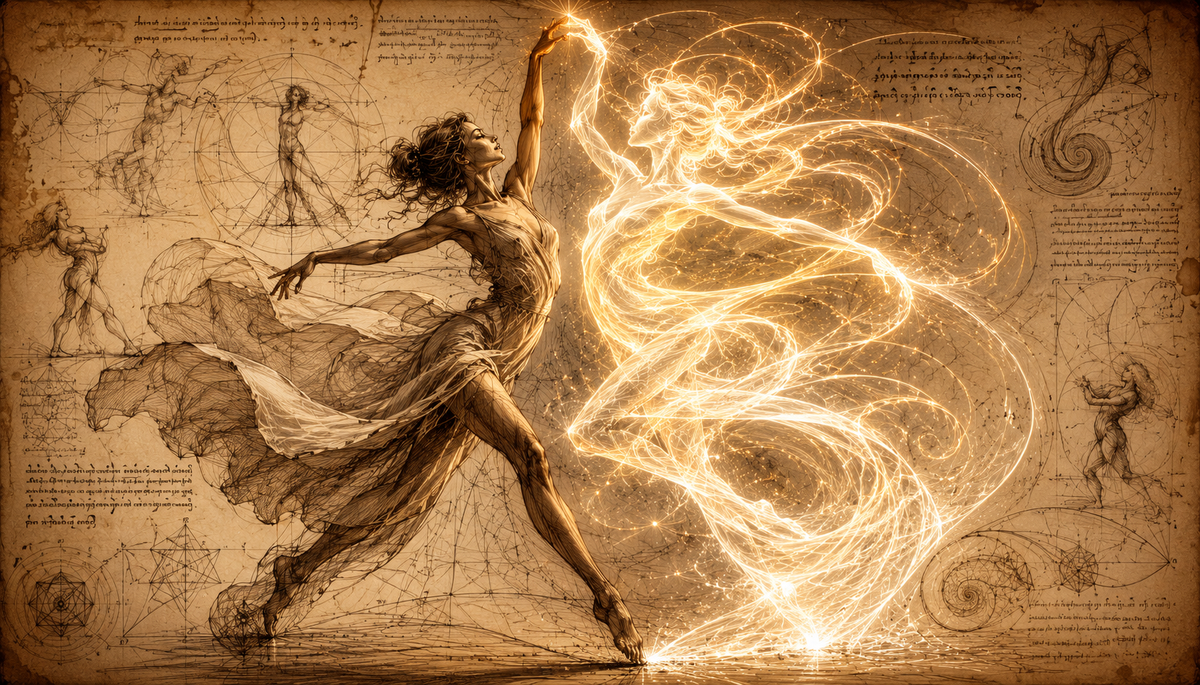
A companion piece on the image, and what it's pointing at
Look at her for a second before you read anything else.
One figure, sketched in pencil and ink: windswept, reaching, caught mid-stride in the particular strain of a body in motion. Beside her, the same figure again, but rendered in light. Same gesture, nearly. Same reach. But where the first is effortful muscle and tendon and the visible work of holding a difficult pose the second is unstrained. Lit from within. Already there.
The instinct is to read this as two beings. A woman, and her spirit, or her angel, or some luminous double standing just beyond her. That reading is wrong, and it's worth sitting with why, because the correction is the whole point.
It's one dancer. Drawn twice. Once as effort. Once as what the effort was always reaching toward.
A very old image for a very specific problem
Cultures that took the inner life seriously kept reaching for the same metaphor, independently, across centuries that had no contact with each other. In the Hindu tradition, Shiva is not depicted seated in stillness he's depicted dancing, the Nataraja, creation and dissolution both happening in the same continuous motion, a ring of fire around a figure who never stops moving. The Sufi tradition built an entire devotional practice around literal turning, the whirling of the dervish, body in motion as the technique for arriving at what doesn't move. Even in traditions that didn't formalize it into ritual, the image recurs informally: the soul as a dancer, the self as something always in motion around a center that isn't.
These traditions weren't being decorative. They were solving a specific problem: how do you point at something that doesn't change using an art form, the body, that can't stop changing? Dance was the answer, again and again, because dance is the one form of motion that can represent stillness without becoming static. The dancer moves. The center she moves around does not.
That's the image in front of you. Not two beings. One motion, and the stillness it's organized around.
What's actually agitating the water
Here is where the metaphor stops being decorative and starts being a claim about mechanism.
The brain runs a process researchers call it the Default Mode Network that is almost never fully off. It's the machinery of self-reference: narrating, planning, comparing, defending, replaying. It is, by some measures, one of the most metabolically expensive things the brain does, and it runs more or less continuously, even especially when you're not doing anything in particular. It is, in a very literal sense, the brain building the dancer: assembling a continuous, coherent, defended sense of you, moment to moment, out of memory and prediction and narrative glue.
This is not a flaw. It's necessary architecture. Without it, you couldn't hold a thought, keep a promise, recognize your own face in a mirror, or function as a person across time at all. The dancer has to dance. The ego has to construct.
But the construction has a cost: it's loud. It agitates the surface it's built on top of. And what gets obscured by that agitation isn't another thought, or a better thought, or a quieter version of the same machinery. It's something the machinery never produced in the first place the simple, prior fact of awareness itself, present underneath the narration whether the narration ever quiets down or not.
The light in the image isn't a separate figure standing apart from the work. It's what's visible when the water stops being thrown into chop by all that necessary motion. Same dancer. Same self. Just for a moment not agitating its own reflection.
The dance doesn't end
Here's the part the image gets right that most spiritual writing gets wrong: the two figures are reaching toward each other, not merging into one. Hands close, not touching.
That's accurate. The recognition that there is something underneath the construction, call it awareness, call it the witness, call it whatever language your tradition hands you, doesn't end the construction. The ego doesn't go anywhere. It can't; you still need it to cross the street and remember your own name. What changes is subtler and, in its way, more demanding: the ego keeps building, keeps narrating, keeps explaining and now there is something watching it do that, undisturbed by the noise.
People who have touched this directly through crisis, through practice, through states that strip the construction away for a moment and then hand the person back to ordinary life describe almost exactly this. The self resumes its habits. But it cannot fully reclaim its old, unquestioned dominance, because it has been seen through once. What begins after that isn't stillness. It's a permanent, ongoing dance between the part of you that builds and the part of you that watches the building neither one winning, neither one disappearing.
Reaching, not touching. Because the reaching is the practice. It was never meant to resolve.
So look again. The figure on the left is not separate from the figure on the right, working hard to become her. She already is her agitated, in motion, doing the necessary work of being a person in time. The light isn't somewhere else, waiting to be earned.
It's what she looks like when the water stops being disturbed by her own effort to find it.
This piece accompanies a visual asset developed alongside Awaken: The Turn Inward at the Edge of AI*, currently in progress. The ideas here are developed at length in Movement I (the egoic valve, the Default Mode Network) and Movement III (the ego/awareness dance as the lived, ongoing texture of recognition).*

Member discussion: