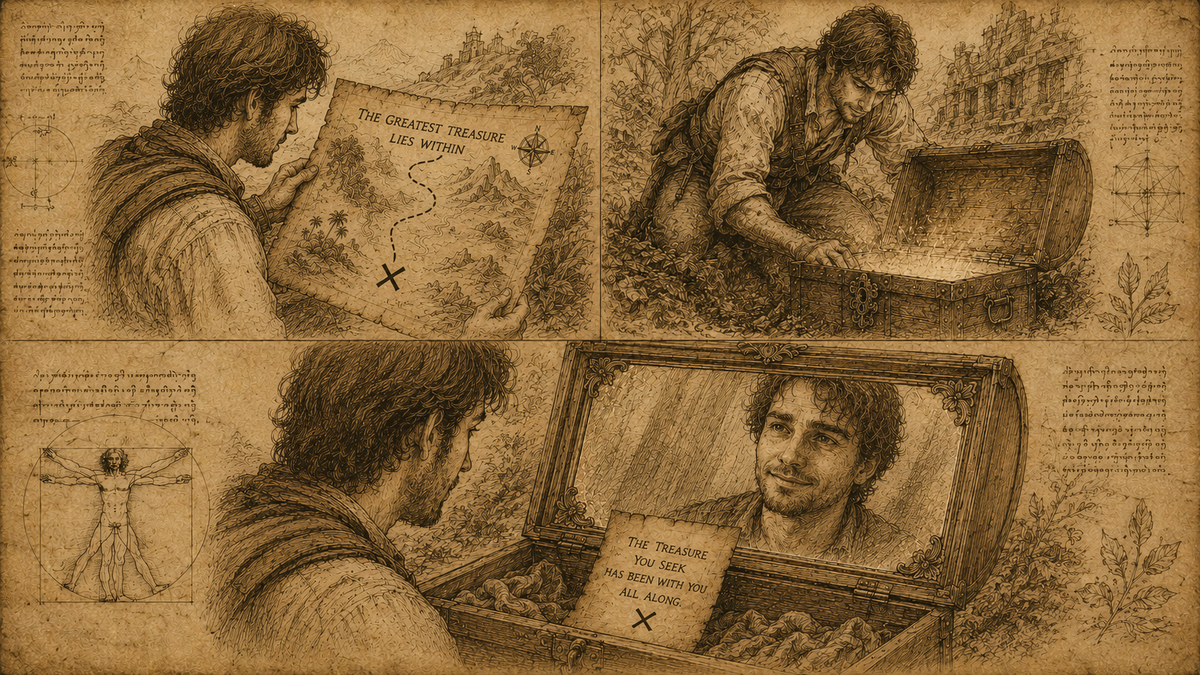
You are the treasure the map was always pointing toward.
There is a story so old it barely needs telling.
A man finds a map. It promises something extraordinary: a treasure, marked with an X, hidden somewhere far from where he stands. He sets out. He crosses mountains. He follows the line on the paper for years, through everything that might have distracted him from it.
He digs. He opens the chest.
And inside, instead of gold, there is a mirror and a note: the treasure you seek has been with you all along.
We tell this story to children and call it a fable. We rarely stop to ask why it keeps getting told, in nearly identical form, across cultures that had no contact with one another. A story that persistent isn't decoration. It's a signal.
A map drawn two thousand years ago
The clearest version of this story is older than fairy tale. It's in the Gospel of Thomas, a text excavated in Egypt in 1945, likely contemporaneous with the gospels in your Bible, but left out of the canon. Saying 51 has the disciples ask Jesus the question every seeker eventually asks: when will the new world come? When will what we're looking for arrive?
His answer collapses the question entirely: what you are looking for has come, but you do not know it.
Not it's coming. Not keep searching and you'll find it eventually. It's already here. The only variable is whether you know it.
That's the treasure map exactly. The search is real, you do have to make the journey, and no one gets to skip it. But the X never moved while you were searching. It was always at a fixed location. The map itself, every doctrine, every teaching, every practice handed down across every tradition was never the treasure. It was the thing that got you walking in the right direction. Arrival isn't acquisition. You don't get handed something new at the end. You recognize what was there before you ever opened the map.
The map is not the treasure. The X is not in the map.
The X is where you are standing.
Why you can't just be told this
If the treasure is already here, why does it take years and sometimes a lifetime to see it?
This is where the story stops being purely poetic and starts being mechanistic. Your brain runs a default network consistently, quieting only when something else takes over that is constantly narrating, predicting, defending, and rehearsing. It is, by design, oriented toward the past and the future. It is almost never oriented toward now, because now has no problem in it for the network to solve.
That network is not your enemy. It built civilization. It keeps you employed, keeps your commitments tracked, keeps your children fed. But it also agitates the surface of the mind the way wind agitates water, and a disturbed surface cannot hold a clear reflection, no matter how bright the source of light above it. The treasure isn't hidden because it's far away. It's hidden because the water won't sit still long enough to show it to you.
The map, in this reading, is every practice that helps the water settle. Prayer. Meditation. Contemplation. Crisis, sometimes, when nothing else will do it. None of them produce the treasure. They quiet the surface long enough for what was already there to be seen.
The oldest version of the map
Three thousand years before the Gospel of Thomas, the Vedantic tradition in India arrived at the identical structure and gave it a name that translates, roughly, to "that art thou." Tat tvam asi. The ground of the universe and the ground of you are not two different things separated by distance. They were never separated. The entire spiritual project, in that tradition, isn't acquisition of the divine it's the dissolving of the belief that you were ever apart from it.
Nisargadatta Maharaj, sitting in a small room above a Bombay tobacco shop in the twentieth century, put it even more bluntly to the seekers who came to him exhausted from decades of searching: you are not in the universe. The universe is in you. He didn't soften it. People had crossed oceans looking for a teacher who would finally hand them the treasure, and he told them, again and again, that the looking itself was the last thing standing between them and what they already were.
Different language. Different century. Same X.
What this means for the search you're on
None of this makes the search optional. The man in the story still had to cross the mountains. The map still had to be followed honestly, with real effort, for real years. Nothing here is an argument for skipping the work, earnestness, every tradition agrees, is what separates a seeker from someone who only likes the idea of seeking.
But it does change what the work is for.
It's not a journey toward a thing that doesn't exist yet. It's the slow quieting of a mind agitated enough that it couldn't see what was already standing in front of it, what was, in fact, never anywhere else.
What would change if you stopped treating the treasure as something still out there, still to be earned, still arriving someday and started treating the search itself as the thing that settles the water?
The ideas developed here connect to the Default Mode Network research and the egoic valve framework explored throughout Awaken: The Turn Inward at the Edge of AI, currently in progress, and to the Gospel of Thomas material explored in depth on the YouTube channel.
Tags: The Turn Inward, Consciousness, Contemplative Traditions, Gospel of Thomas

Member discussion: